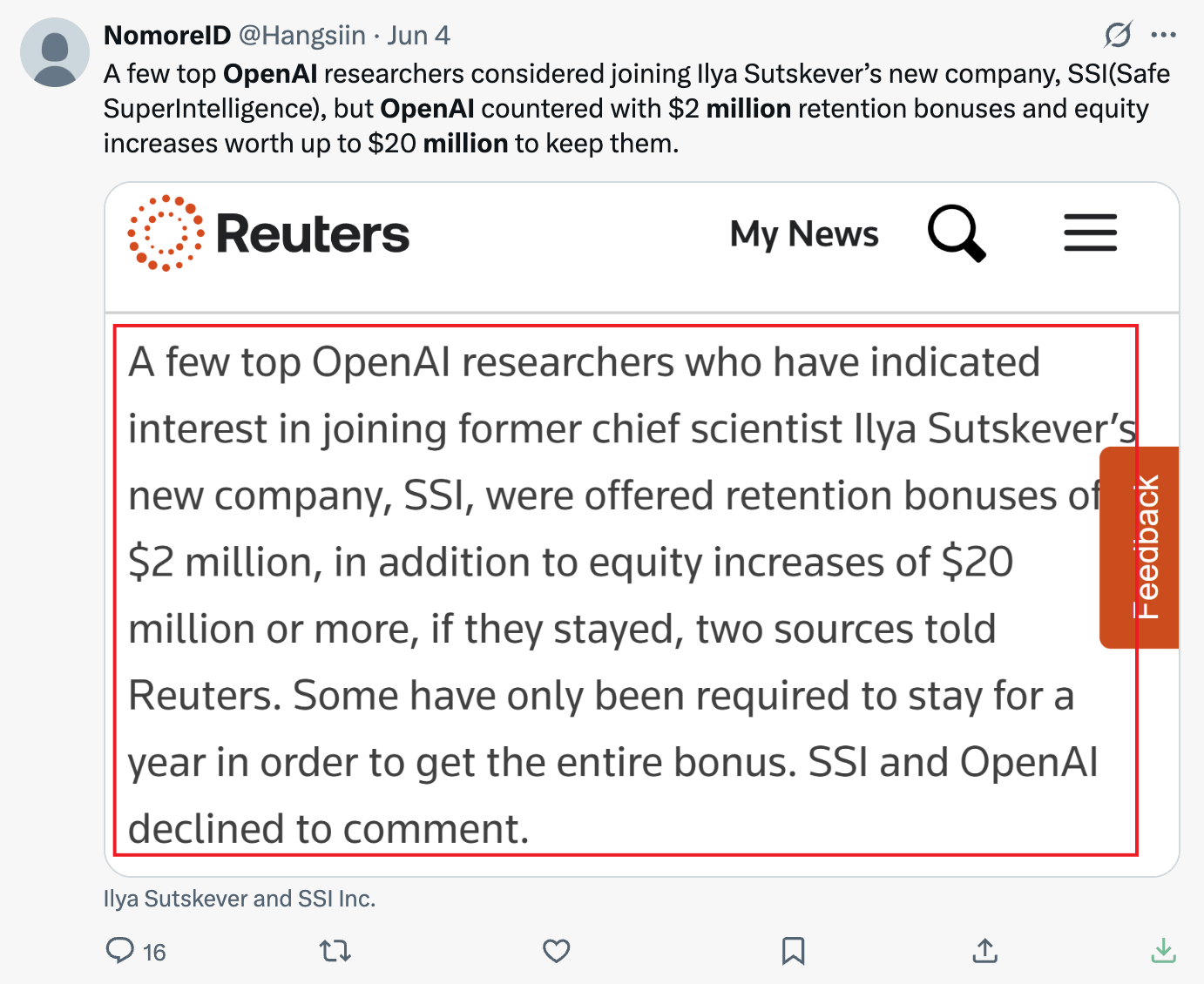
OpenAI just offered researchers $2 million retention bonuses to prevent them from joining Ilya Sutskever’s new company. Google DeepMind countered with $20 million packages. Meanwhile, a Washington Post analysis found that 27% of traditional programming jobs disappeared in the past year.
This isn’t a contradiction. It’s the new reality of programming careers.
Two worlds, one profession
AI is creating a brutal bifurcation in software engineering. At the top, a tiny elite of maybe 5000-10,000 people globally who can direct and create AI models and sysyems are earning more than investment bankers. At the bottom, millions of programmers are competing with AI tools that can generate code faster than they can.
The middle is disappearing.
The Elite Track: AI Research Scientists, ML Engineers, and AI Product Architects. These people don’t write much code anymore—they design systems that AI implements. Equity pushing total packages to $10-20M for top performers.
The Implementation Track: Everyone else. These roles involve translating business requirements into AI prompts, reviewing AI-generated code, and maintaining existing systems. Salaries have flattened and face ongoing automation pressure.

The data tells the story
GitHub Copilot makes developers 55% faster at completing tasks. Microsoft reports AI generates 25% of their new code. But here’s the key insight: junior developers see 39% productivity gains while senior developers only gain 13%.
This means AI is making entry-level programmers immediately productive—but it’s also making them replaceable. The skills that took bootcamp graduates months to learn can now be generated in seconds.
The uncomfortable truth
Programming was always destined to become a winner-take-all field. Software has near-zero marginal costs and unlimited scalability. A single algorithm can be worth billions while a mediocre one is worthless. AI just removed the friction that temporarily protected programmers from this reality.
The question isn’t whether this transformation will continue—it’s whether you’ll be positioned to benefit from it.
What to do
If you’re early in your career, learn to direct AI systems rather than compete with them. Focus on system design, architecture, and translating business problems into technical solutions. These are the skills that become more valuable as AI handles implementation.
If you’re experienced, consider whether you’re on track for the elite tier or the implementation tier. The elite tier requires moving beyond coding to system thinking. The implementation tier, while still valuable today, faces continued automation pressure.
The brutal reality: programming is becoming like writing or music. Since democratization often accelerates winner-take-all dynamics rather than preventing them, a small number of practitioners will capture enormous value while the majority compete for shrinking opportunities.
The opportunity: those who adapt to direct AI rather than compete with it may be entering the most lucrative period in programming history.
The great bifurcation is already underway. The only question is which side you’ll be on.